Boat & Marine
Boat Storage Options Explained: Dry Stack, Indoor, and Trailerable
Boat storage decisions get complicated quickly because the right answer depends on three variables: the boat itself (size, hull material, propulsion), how often you use it, and the climate where you store it. A 22-foot bowrider used twelve weekends a year in central Texas needs a very different solution than a 35-foot cruiser used monthly in coastal Maine. This article covers the major option categories and the trade-offs each carries.
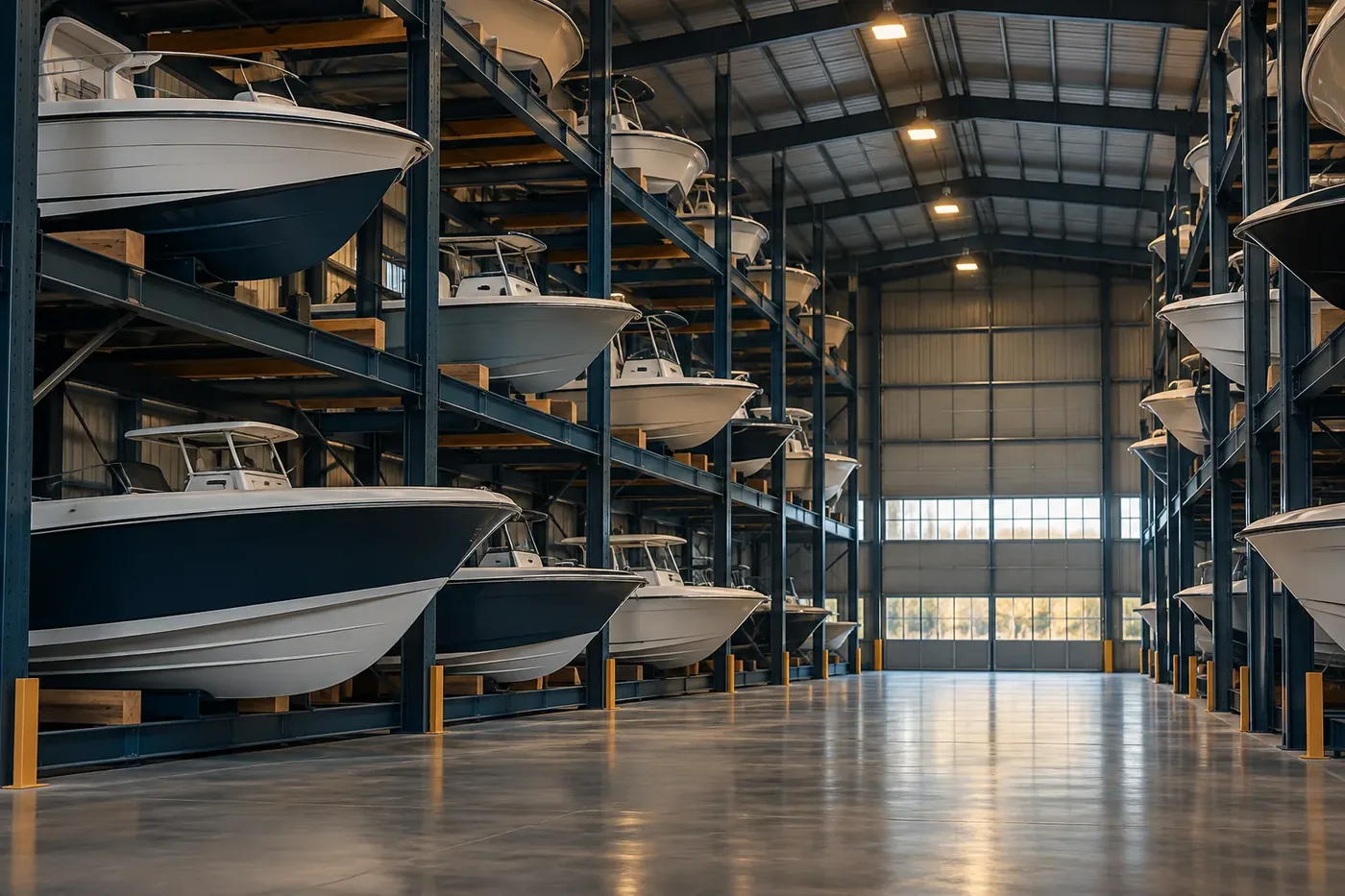
Dry stack storage
Dry stack is the marina version of valet parking. Your boat sits on a rack inside a tall warehouse, and a forklift launches it on demand — usually within 30-60 minutes of a phone call or app request. Costs run $150-450/month depending on boat size and metro, plus per-launch fees in some operations. Dry stack works best for boats up to 32 feet that you use frequently in saltwater, where keeping the hull out of the water between trips dramatically extends maintenance intervals.
Limitations: dry stack is location-bound (you can only use it at the marina that stores you), most operations cap boat size at 32-35 feet, and forklift handling requires a structurally sound hull and pickup points. Cruisers, sailboats, and larger fishing platforms are not candidates.
Indoor heated storage
Indoor heated storage is the gold standard for off-season hold and for higher-value boats. Costs run $200-600/month for a typical mid-size powerboat, and the benefits are substantial: no UV degradation, no freeze-thaw cycling, no winter pest intrusion, and (in good facilities) the option of services like shrink-wrap, battery tending, and pre-season detail. Many indoor facilities also offer optional climate control for boats with sensitive electronics or gel-coat finish concerns.
Choose indoor when the boat is high value, when you store for more than four months, or when local winters bring sustained subfreezing weather. The cost premium over outdoor trailer storage is real, but so is the depreciation difference at five years.
Trailerable indoor storage
For trailerable boats — typically up to 26-28 feet — a standard self-storage facility with a tall enough door is often a viable option at $100-300/month. You get full weather protection without paying marina rates. Most facilities offering this option require the trailer to fit through a 12-foot or 14-foot door and to fit within a 40- or 50-foot deep unit. Verify dimensions including swim platform, outboard motor in trim-up position, and antennas.
Outdoor trailer storage
Outdoor lots are the cheapest option at $40-150/month and the right answer for older runabouts, fishing boats with practical finishes, and any boat used heavily enough that the trailer rarely sits more than a week or two. Pair with a quality custom-fit cover (not a generic tarp), and prepare to clean the cover periodically as it traps moisture.
Saltwater considerations
- Flush the engine after every saltwater use, regardless of storage choice.
- Wash hull and trailer thoroughly before any indoor storage; a dirty trailer rusts inside a covered bay.
- Inspect bottom paint annually; haul-out and repaint cycles vary by region but typically 2-4 years.
- Replace zincs/anodes per schedule; saltwater consumption is faster than freshwater.
- Consider a corrosion inhibitor spray for engine and electrical components in stored boats.
Winterization basics
In any climate that sees subfreezing weather, winterization is non-negotiable. Drain all water systems including engine cooling, freshwater plumbing, head, and AC raw-water loops. Add antifreeze to engine and plumbing. Top off fuel and add stabilizer. Disconnect or maintain batteries. Indoor heated storage relaxes some of these requirements but not all — the engine still needs the same treatment because indoor temperature can fall during a power failure.
Insurance and access
Confirm your boat policy covers stored conditions. Many policies require the boat to be on a rated trailer or in an approved storage location; verify your facility qualifies. For dry stack and indoor heated, also verify access hours match how you plan to use the boat — most facilities are 9-5 or 7-7, with limited weekend hours that may not align with peak summer demand.
Find the right facility
Ready to put this guide to work? Browse storage by category or find facilities in your state.