RV & Vehicle
The RV Storage Checklist: Before, During, and After
Storing an RV well is the difference between rolling out in April with a working rig and spending the first weekend at the dealer for a battery, a wasp removal, and a coolant flush. None of these are hard problems, but all of them get worse with neglect, and the storage facility you choose only solves part of the problem. Most of the work is on you.
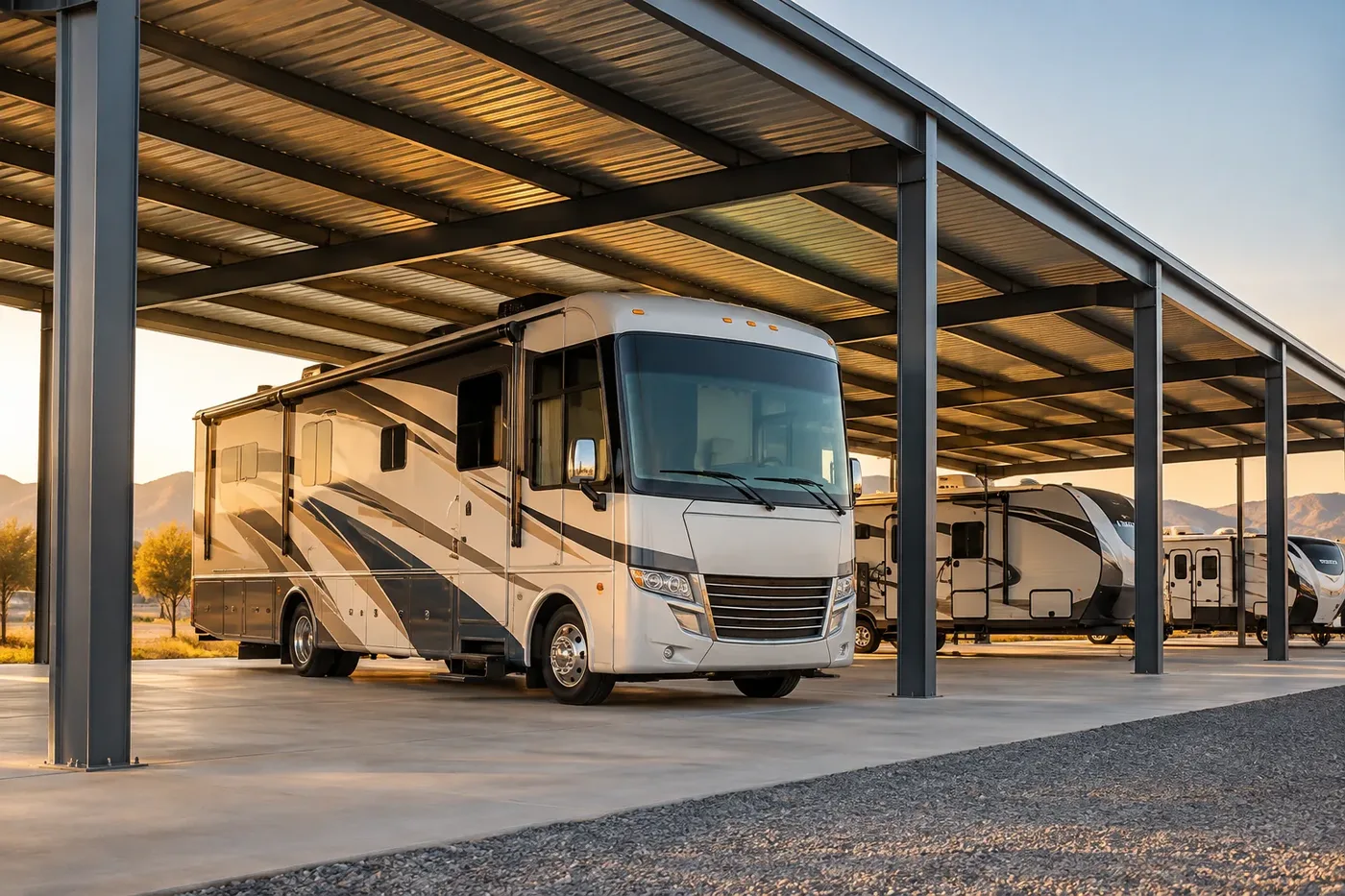
Choosing a facility
You have three options. Open lots are cheapest, run roughly $50-150/month depending on metro, and leave the rig fully exposed to weather. Covered lots — usually a steel canopy with a concrete pad — run $120-250/month and protect against UV and most precipitation while leaving sides exposed to wind and pollen. Enclosed bays are the gold standard at $200-450/month, with full weather protection, optional shore power, and (in better facilities) climate stability.
Pick based on rig value and storage duration. A $40,000 used Class C parked for a winter is fine on a covered lot in most climates. A $200,000 Class A parked for six months in coastal Florida wants enclosed storage with shore power for the chassis battery. The rule of thumb: any rig you would not park on the street for six months should not be on an open lot for six months.
Pre-storage checklist
- Fill the fuel tank and add a stabilizer (Sta-Bil or PRI-G). Drive 10 miles after adding to circulate.
- Drain and refill freshwater system; close water heater bypass.
- Drain and clean black/grey tanks; leave valves open if facility allows, with caps in place.
- Disconnect chassis and house batteries, or install a battery maintainer if shore power is available.
- Remove all food, including spices and sealed cans (cans rust and split with temperature swings).
- Pop the fridge open with a wedge to prevent mold growth in the door seal.
- Inflate tires to the upper end of the rated pressure to prevent flat-spotting.
- Cover tires from UV if outdoors; consider tire socks or covers.
- Place dryer sheets, peppermint oil, or commercial rodent deterrents in known entry points.
- Wash and wax exterior; treat seals and slide gaskets with 303 Aerospace Protectant.
- Photograph all sides for insurance baseline.
During storage
For long-term holds, plan to visit monthly if possible. Check tire pressure, look for water intrusion at all roof penetrations, run the generator under load for 30 minutes if applicable, and inspect for pest entry. If the facility has shore power, your battery maintainer should keep things alive — confirm voltage on each visit. If you cannot visit, consider a remote-monitor product that watches battery, temperature, and intrusion.
Spring launch
- Reconnect batteries and verify voltage on all systems.
- Inspect all tire sidewalls for cracks; check pressure when cold.
- Sanitize freshwater system with a bleach solution, then flush three times.
- Test all 12V and 120V systems before driving.
- Inspect roof seals and slide seals — these are the most common annual maintenance items.
- Run the engine for 15 minutes at idle, then take a slow first drive of 5-10 miles.
- Service the generator if the hour count crosses an interval.
Insurance and contracts
Most facility insurance excludes the rig itself — it covers the unit and surrounding property only. Verify your auto/RV policy covers comprehensive while in storage; many policies offer a discount for storage periods. For high-value rigs, an agreed-value policy is worth the extra annual cost. Most facilities offer month-to-month contracts; longer terms typically discount 5-15%.
Find the right facility
Ready to put this guide to work? Browse storage by category or find facilities in your state.